
We offer a comprehensive suite of GPCR functional assay services — from focused panel screens to concentration-response characterization, inter-species comparisons, and proton sensitivity analysis.
Panel Assays
We provide high-sensitivity GPCR panel assay services using proprietary technology. Panel options range from focused FlexPanel48 panels to large-scale screening of up to 294 human GPCRs and over 250 mouse GPCRs, enabling efficient activity profiling across your targets of interest. Each panel is fully customizable — receptors can be freely replaced or supplemented with mouse orthologs — supporting applications from orphan GPCR analysis to off-target safety profiling. A sample report is available here (PDF). The receptors eligible for our panel assays are listed at the bottom. If you have any questions, feel free to ask us.
FlexPanel48
FlexPanel48 is a series of focused panels with 48 receptors consisting of custom panels and therapeutic area panels.
Best for: targeted 48-receptor screening when you already know which pathway or therapeutic area matters.
Custom Panels
- One can choose 48 receptors from the >550 human/mouse GPCRs on our list.
- Two assay modes, the agonist and antagonist modes, are available. Orphan GPCRs are assayed in the agonist mode only.
- The two assay modes may coexist in a single panel.
- One can replace receptors in a panel with other human receptors or mouse orthologs.
FlexPanel48 Therapeutic Area Panels
13 Therapeutic Areas
- Immunology/Infection
- Oncology
- Hematology
- Endocrinology/Metabolism
- Psychiatry
- Neurology
- Ophthalmology
- Cardiology
- Respiratory
- Gastrointestinal
- Dermatology
- Musculoskeletal
- Urology/Reproduction
- Updated in January 2026 based on the latest disease–gene relevance data from DISGENET.
- The 48 GPCRs with high disease–gene association scores are assorted.
- The receptors in each panel are listed below.
- Two assay modes are available: agonist and antagonist.
- Panels are highly flexible, and receptors can be freely replaced or customized to meet specific project needs.
Best for: focused profiling within a specific disease area, when 48 receptors covers the relevant biology.
Panel Assay Examples
FlexPanel48 Endocrinology/Metabolism Panel
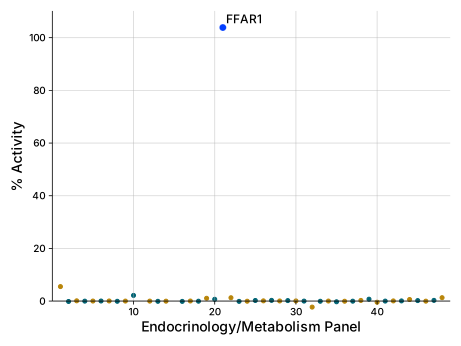
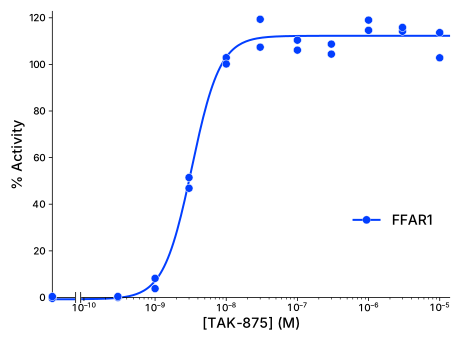
TAK-875, a Phase 3 antidiabetic, was screened in the agonist mode in the FlexPanel48 Endocrinology/Metabolism Panel (Figure 1). TAK-875 selectively activated free fatty acid receptor 1 (FFAR1). Next, TAK-875 was shown to activate FFAR1 in a concentration-dependent manner (Figure 2).
Endocrinology/Metabolism Panel Receptors
FlexPanel48 Psychiatry Panel
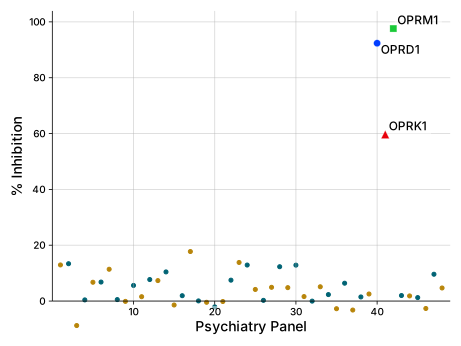
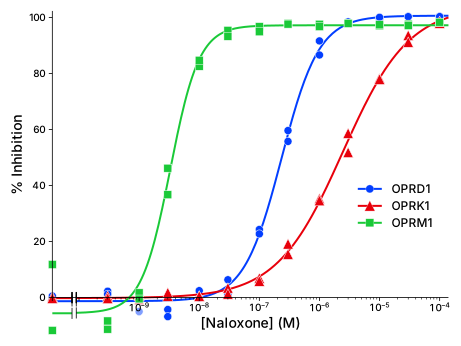
Naloxone, the opioid reversal drug, was screened in the antagonist mode in the FlexPanel48 Psychiatry Panel (Figure 3). Naloxone selectively antagonized opiate receptors OPRD1, OPRK1, and OPRM1. Next, naloxone was shown to antagonize the three opiate receptors in a concentration-dependent manner (Figure 4).
Psychiatry Panel Receptors
Large-Scale Comprehensive Panels
Our large-scale panel assays allow comprehensive screening for up to 294 human GPCRs and >250 mouse orthologs.
The total of >550 human and mouse GPCRs amenable to panel assays are listed below.
Best for: unbiased, broad selectivity screening when the relevant off-target receptors aren't yet known.
Panel Assay Example
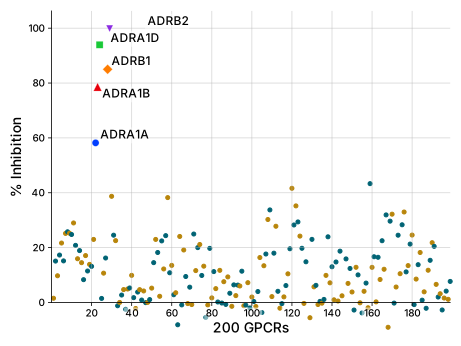
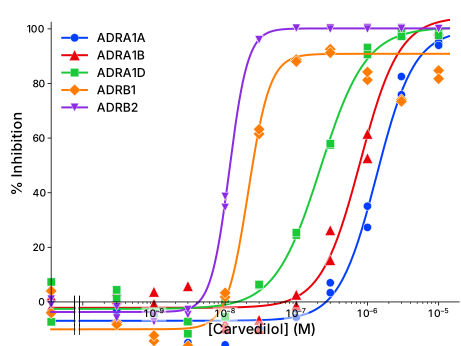
Carvedilol, an anti-hypertensive agent, was screened in the antagonist mode for 200 non-orphan GPCRs (Figure 5). Carvedilol selectively antagonized α1A, α1B, α1D, β1, and β2 adrenoceptors. Next, carvedilol was shown to antagonize the above receptors in a concentration-dependent manner (Figure 6).
Safety Panels
Our GPCR Safety Panels are designed to help evaluate the off-target potency of candidate compounds in drug discovery and preclinical research. These panels include GPCRs often linked with common adverse reactions, making them a practical resource for pharmaceutical R&D.
- Standard GPCR Safety Panel: Features a minimal set of 24 representative GPCRs, allowing for testing compounds in both agonistic and antagonistic modes.
- GPCR Safety Panel Premium: Includes 31 additional GPCRs from the same receptor families for broader coverage.
Best for: off-target liability screening before lead selection, to flag adverse-reaction risks early.
Key Advantages
Early Identification of Off-Target Interactions
Detect off-target interactions at the lead selection stage, which is crucial for mitigating unwanted activities through structure-activity relationship (SAR) studies.
Predictive Insights into Clinical Adverse Reactions
Predict clinical adverse reactions that may go unnoticed in vivo, such as valvulopathy associated with 5-hydroxytryptamine receptor 2B (HTR2B) agonists, using human GPCRs for better correlation with clinical effects.
Cost-Effective In Vitro Testing
Test a large number of compounds cost-effectively in vitro on human targets, facilitating early-stage drug discovery and lead identification.
Relevance to Physiology
Our proprietary GPCR functional assay measures the potency of test compounds against GPCRs, providing physiologically relevant insights aligned with clinical implications.
Accelerated Research Timeline
Obtain quicker results and explanations of off-target effects, allowing for efficient data integration from safety pharmacology profiling, pharmacokinetic experiments, ADME, and efficacy models.
Flexibility for Streamlined Research
Our GPCR collection covers 550 human receptors and mouse orthologues. We also offer the flexibility to prepare orthologues for other species used in preclinical studies, ensuring customized panels to suit your research needs.
Competitive Benchmarking
Benchmark against competitor compounds to support a best-in-class development strategy, addressing pharmacological promiscuity early on.
Panel Receptors
Listed are the GPCRs amenable to panel assays. Each panel is customizable.
Concentration-Response Analysis
Beyond panel screening, we offer concentration-response analysis to characterize the potency and efficacy of your compounds against any GPCR in our library — including G12/13-coupled receptors, which have long been difficult to evaluate due to the lack of reliable assay methods. Assay modes include agonist, inverse agonist, antagonist, PAM, and NAM, and study designs are fully flexible — covering the number of concentrations, replicates, and compound combinations. Results are delivered as sigmoidal curve fits with EC50/IC50 values, providing the quantitative pharmacological data needed for SAR analysis and lead optimization. A sample report is available here (PDF).
Examples
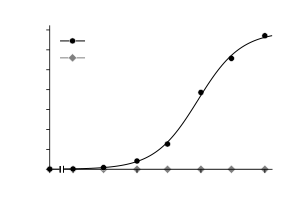
Agonist mode: Concentration-response curve for angiotensin II at AGTR1 in the agonist mode. AGTR1-expressing reporter cells were treated with increasing concentrations of angiotensin II.
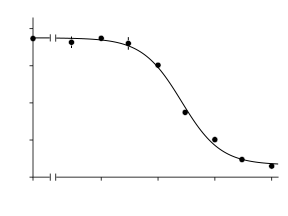
Antagonist mode: Concentration-response curve for valsartan at AGTR1 in the antagonist mode. AGTR1-expressing reporter cells were treated with increasing concentrations of valsartan in the presence of a fixed concentration of angiotensin II.
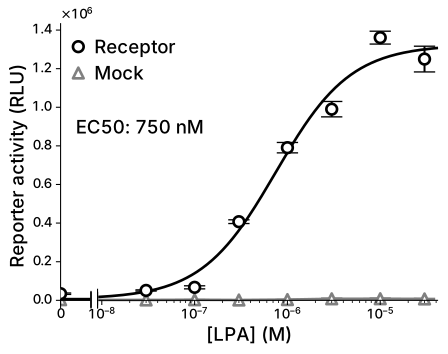
G12/13-coupled receptors: G12/13-coupled receptors have historically been among the most challenging GPCRs to assay. The concentration-response curve shown here for LPAR6, a representative G12/13-coupled receptor, demonstrates that our platform evaluates them with the same reliability as any other GPCR.
Best for: detailed EC50/IC50 potency data on a specific target, for SAR analysis or lead optimization.
Inter-Species Comparison
GPCRs can exhibit marked pharmacological differences between species, with ligand potency and receptor sensitivity varying considerably between human and non-human orthologs. Confirming that preclinical findings translate across species is therefore a critical step in drug development. Our platform supports direct comparison of human and animal GPCRs under identical assay conditions, providing translational insight to guide candidate selection and IND-enabling studies.
Examples
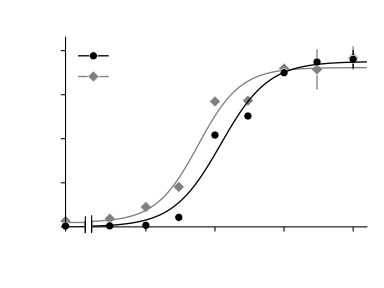
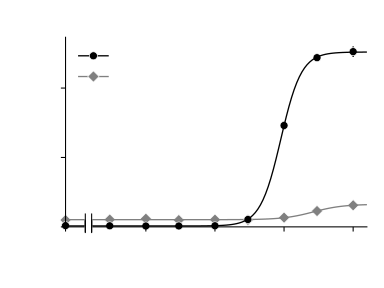
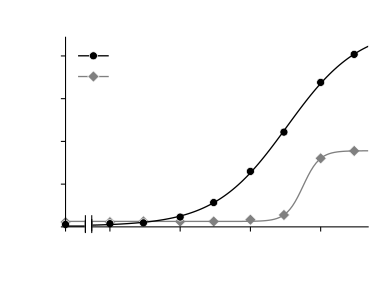

To illustrate inter-species pharmacological differences, we compared the responses of human and mouse orthologs of FPR1 and C5AR1 to a panel of agonists and antagonists. For FPR1, WKYMVM showed comparable agonistic potency at both the human and mouse receptors, whereas fMLP was substantially more potent at the human ortholog (first two panels). For C5AR1, both C5a and avacopan elicited markedly different responses between the human and mouse receptors (last two panels), highlighting the species-dependent pharmacology that can go undetected when only one ortholog is characterized.
Best for: confirming a candidate's pharmacology translates from animal models to humans, ahead of IND-enabling studies.
Proton Sensitivity Analysis
Certain GPCRs, including GPR4, GPR65, GPR68, and GPR132, are activated by extracellular protons and play roles in physiological and pathological pH sensing. The concentration-response curves shown here demonstrate that our platform reliably captures the pH-dependent activity of these receptors, enabling functional characterization of proton-sensing GPCRs with the same sensitivity as conventional ligand-receptor systems.
Best for: characterizing proton-sensing GPCRs relevant to ischemia, inflammation, or tumor microenvironments.
Examples
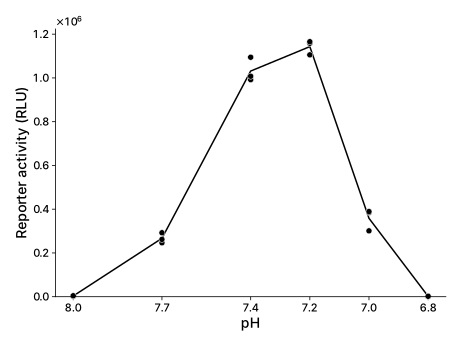
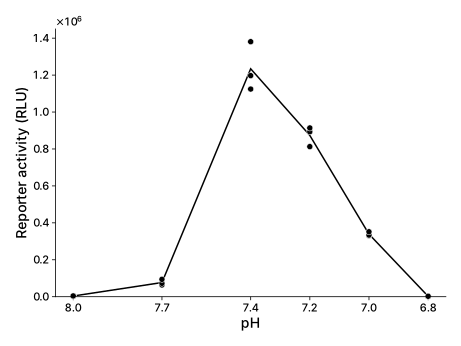
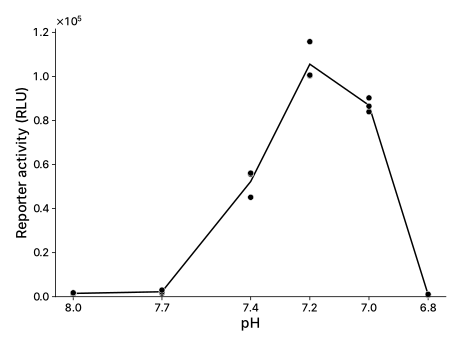
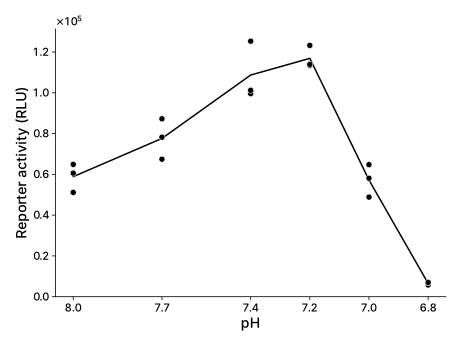
To characterize proton sensitivity across representative receptors, we measured the pH-dependent activity of GPR4, GPR65, GPR68, and GPR132. All four receptors showed increasing activity at lower pH values, consistent with activation by extracellular protons. The responses were well-resolved across the physiological to mildly acidic pH range (pH 6.8–8.0), demonstrating that our platform reliably captures graded pH-dependent signaling across proton-sensing GPCRs.